Tributes
To remember the good times spent with some of our companions, we’ve decided to write a short tribute to them.

Cheyenne
Cheyenne
March 4, 2016: Cheyenne falls asleep… 2:30 pm, Adeline, calls us, in tears, Cheyenne is lying in the meadow…she can’t get up anymore! The vet quickly arrives on the scene…her pulse has slowed, the mare is in a state of shock and very weak. Cheyenne had been losing condition for weeks, and blood tests last week revealed that she had cushing’s disease…a rapid deterioration in just a few days. We decided to let Cheyenne go with dignity and without fuss, even though she wasn’t that old, only 22.
Cheyenne had been sequestered in 2008 with the group of 17 horses. She was in a miserable state… after having been rehabilitated by Jean-Marc, Cheyenne was adopted by Adeline for a quiet retirement. She enjoyed it for 8 years. Thank you Adeline for everything…. And to you, sweet mare, we wish you all the best for the future!
Princess B
Princess B
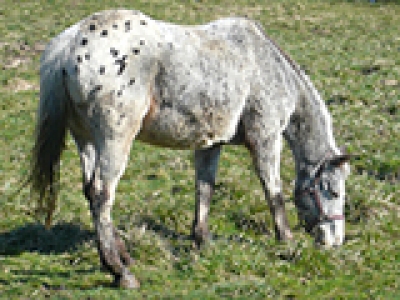
Princesse, sequestered in 2008 with 14 other horses, was adopted by Caroline. After many happy years working and riding, Princesse’s health began to fail. Caroline is keeping her in retirement, to her and her mom’s great delight, to pamper her for many years to come. Message from Caroline Bieri: Princess has been sharing my life for 10 years now, and I’m so happy to have her. She’s doing really well and is now 21 and in great shape.
Texas
Texas
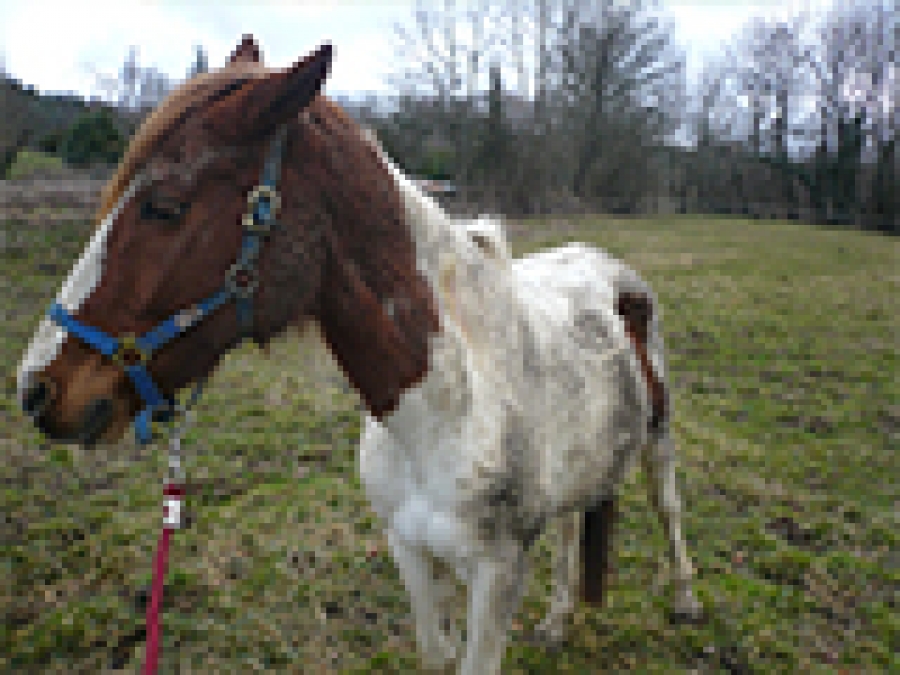
Texas, sequestered with 14 other horses in 2008.
Message from his foster family:
Here are some photos of Texas, who has been in a branch of the Refuge for a year and a half now, where he is having a great retirement with beautiful meadows. We love to go for walks with him (me and his granny too? who also likes to come and find him) and go on lovely walks by hand.
Texas enjoys grazing again and again, whether it’s under a beautiful sun, or even when it’s snowing, he always manages to find a few little twigs of grass. He loves kisses and knows he’ll never escape his big cuddle.
It’s been 9 years since I adopted him, and they’ve been the best 9 years of my life. He’s an adorable, calm, very, very greedy horse who’s currently 32 years old. Despite his age, he’s doing wonderfully well and makes us very happy.
Zouzou
Zouzou
Zouzou, June 15, 2019
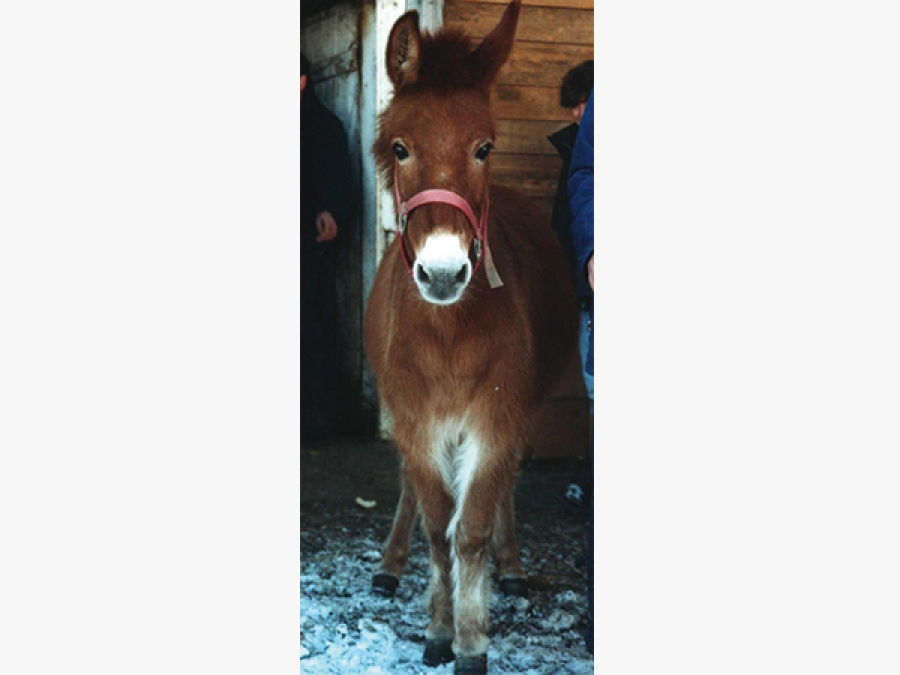
12 years in foster care….it’s already a chance…but on top of that when you know the “beast”, it’s an unexpected chance….Zouzou, she was a number!!!! Bardot had a strong character and 2 qualities: she was sensitive and didn’t like contact. And yet one person understood her: Marina appreciated her for who she was.
Saturday June 15, Zouzou was at her worst following a violent colic. Immediately attended to by the vet, Zouzou was perfused and catheterized…but unfortunately, nothing helped. A torsion is at the origin of these monstrous sufferings which will push her family to let her go to put her out of her misery.
Marina, you who live for all your animals, we can only say a huge THANK YOU, really! Zouzou enjoyed all those years with you, and she left at the age of 33…at home and surrounded.
Our hearts go out to you at this difficult time….
Lilac
Lilac
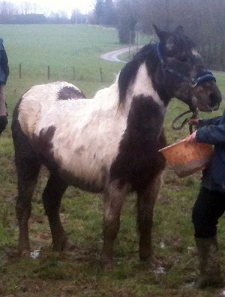
July 15, 2017: Lilas Recovered in March 2016, Lilas lived rough. Fearful, she had to be approached quietly, and her feet were still delicate. But with time, Lilas became more sociable and accepted some care. But for the past few weeks, Lilas has been losing weight visibly, losing condition…. and refusing to eat her rations. She continues to “graze” a few blades of grass, but her health is deteriorating. The vet will have to come urgently for an oesophageal blockage. Is there a link with her deteriorating health? We ask for a blood test, but the results are very bad; lymphoma is seriously suspected and nothing more can be done. In view of Lilas’s condition, we decide to put her out of her misery and put her to sleep quietly, without waiting for the urgency of her condition, which will continue to deteriorate day by day. These are always difficult decisions to make, but it’s at times like these that the vet who looks after our horses is there to help us make the right decision at the right time.
Thanks to Béat, who took Lilas in and gave her a year’s worth of retirement with little touches every day!
A little mare with a strong character, you were able to enjoy a year that was different from the other 18… From now on, time will count for nothing…. Happy trails to you Lilas!
Message from Béat, her foster family:
For me it was a great gift to have this little mare in my life for a while.
What a revelation when she showed me her immense gentleness and love, which she had had to hide and lock away for so long.

Pompon
Pompon
January 29, 2016: Pompon, 30 years old Pompon, nearly 30 years old, taken in a few months ago following the death of his owner, had to be put to sleep this morning. We had boarded him with 5 other horses on the heights of Nantua. For the past 3 days, we’ve had to help get him up, and this morning was the last time… Unfortunately, the stiffness of old age got the better of him. His park buddy of many years, Rocky, will have to continue his journey without him…tomorrow, we’ll be on hand to see how he’s coping with this sudden loss.
Hi Pompon, someone’s waiting for you up there…Bonne route l’ami!
Charlotte
Charlotte
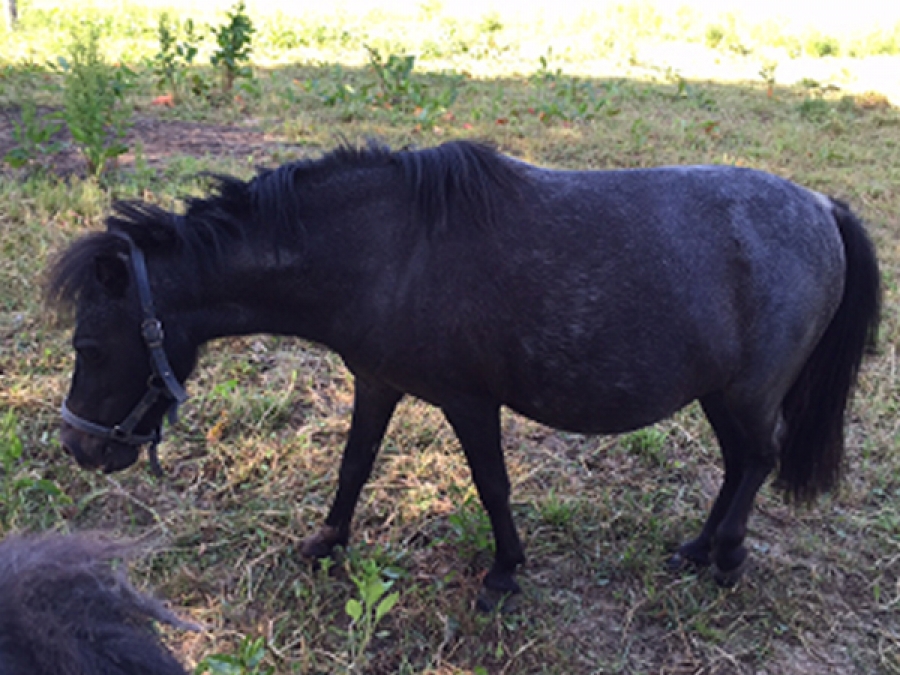
Charlotte, September 18, 2018Charlotte had been entrusted to the Refuge in 2007 with 8 other ponies, they were quite a family. For the past 2 years, 6 of them have been adopted by the same foster family, who offer them a dream life. But following an incomprehensible weight loss, Charlotte underwent clinical examinations in January 2018, diagnosis: tumor…. No sign of pain, but her condition will gradually diminish. In agreement with the foster family, Charlotte will enjoy day by day and when the time comes, she will be put to sleep with her loved ones.
Charlotte enjoyed the spring and summer, free to roam the property with Romeo by her side. Supplemented several times a day, Charlotte is thin but retains her quality of life. Unfortunately, for the past few days, Charlotte has had difficulty getting out of bed, her appetite has diminished and she has become extremely thin….
Charlotte fell asleep surrounded by her family, with all the ponies around her to bid her farewell. A gentle pony, discreet and a good mother. Charlotte was Smocky Jo’s mom. 16 is too young to go, but one thing’s for sure, you’ll have had a lovely, pampered life on this earth….So have a safe journey home, Charlotte, and watch over your little world…. Many thanks to her family who gave her the best…..
Minouche
Minouche
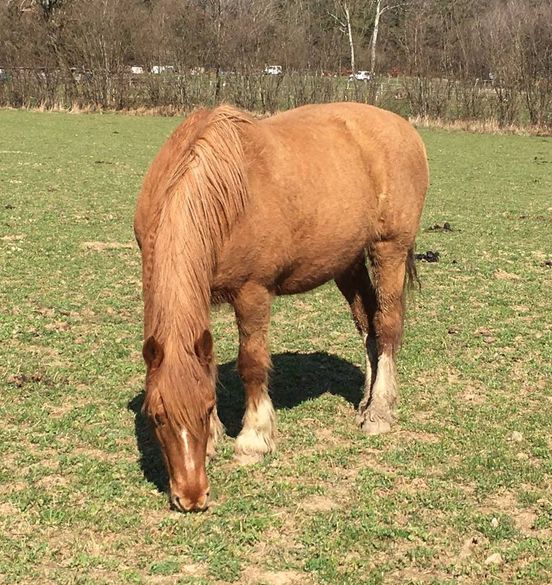
Minouche, September 1, 2018Franche-Montagne bred, Minouche was 17 years old when she arrived at the Refuge in November 2015. We had taken her in due to the advanced age of her owner, who had non-compliant installations, and had to reduce his herd. Minouche has always had a special character. In her early years, she could sometimes be kicked or bitten. Furring, cushing and melanoma were part of her daily routine, yet she was able to enjoy 3 years of retirement. A family adopted her when she arrived at the Refuge, but asked us to take her back in January 2016. Minouche spent her days at the rack, never keeping up with the rest of the group. Her weight gain was becoming worrying, so we took her back to one of our antennas. This past year, Minouche had found a balance playing “nanny” to the foals and was almost showing signs of gratitude to the people looking after her. Now more than sociable, she was finally enjoying moments of brushing and petting.
On this Saturday morning, Minouche is losing her balance…the more time goes by, the more violent the loss of balance becomes. She’s showing signs of ataxia, loss of consciousness and sight. The vet confirms a stroke or a misplaced tumour, and there’s only one way out: to accompany her to prevent her seriously injuring herself in one of her falls….Minouche will fall asleep surrounded and will let go quickly….Despite this very rapid departure, we are relieved that Minouche has left in this way, as we often had questions about her well-being with the furring and her ogre-like appetite. For you, Minouche, green pastures full of clover await, but also the sweet Gamine, whom you “raised” and who left us at 18 months ….Hi Grosse Dondon, have a good trip….
Snow
Snow
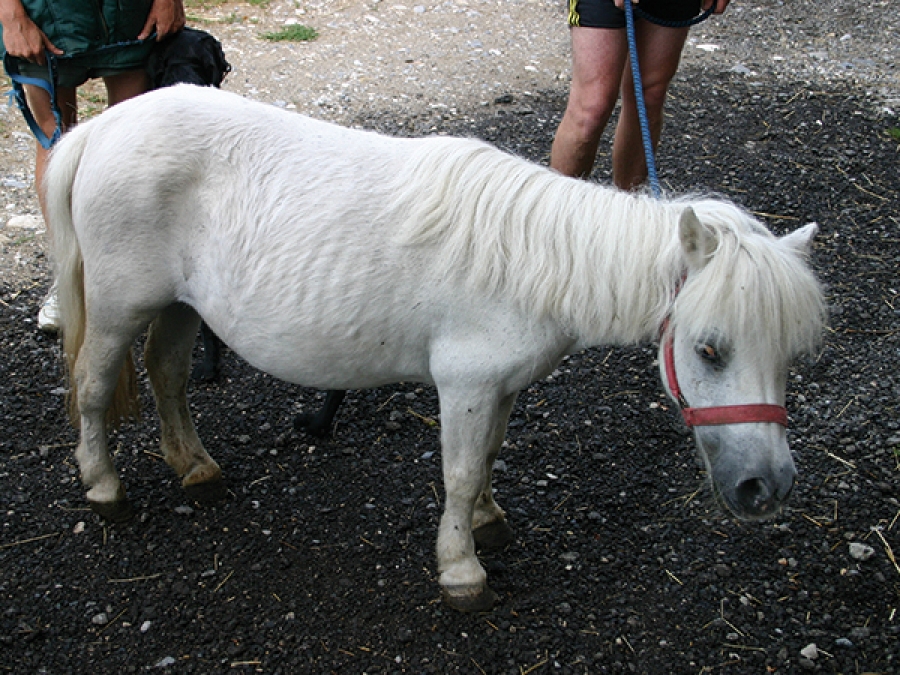
October 27, 2016: Neige, 41 years oldNeige….41 years old….he enjoyed a wonderful retirement with Regula. A Ponette taken in by the Refuge in 2004, following the death of her owner, Neige and Jimmy were the 2 inseparables, but Jimmy fell asleep in 2013.
On the heights of the Bernese Jura, with facilities suitable for all seasons, Neige led her little life in a herd with ponies of her size, that is, not very tall (75 cm on average). Despite all the vigilance and first-aid care, Neige succumbed to a devastating colic… As we know, colic is a major cause of death in horses, and at 41 years of age, it would be unreasonable to attempt an operation.
Neige fell asleep before the pain started up again… We’d like to thank her foster family, who do so much for the animal cause. Dogs, horses, ponies, donkeys, they try to find solutions for each species.
Neige…for the past 12 years, you’ve enjoyed a golden retirement, you’ve left this little paradise to join another one but where Jimmy is waiting for you with his hoof firmly on the ground…Bonne route petite ponette…
Gysmo
Gysmo
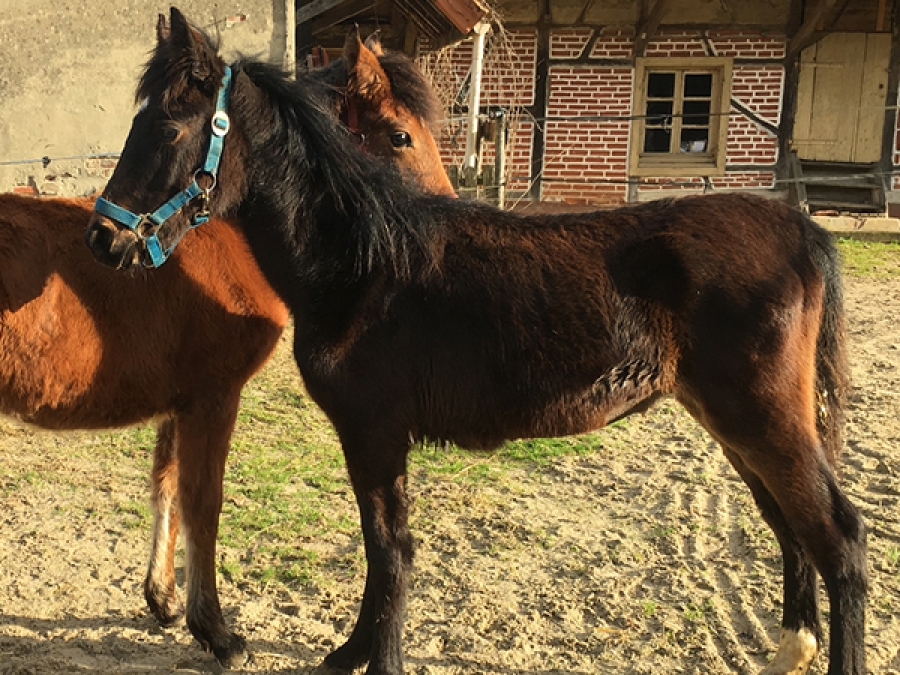
April 26, 2017: Gysmo dies at 11 months.in a meadow with a herd, Gysmo, a young foal is already away from the herd….he gives us the alarm. With the information we had gathered, we were able to trace the herd’s origin, as well as its intended destination. A week later, we took charge of the 8 horses (October 2016) Gysmo was already very calm…too calm. First aid and food supplements to help him get back on his feet. After a short time, Gysmo will have to fight strangles. But he’ll manage. There was still the problem of persistent diarrhea. In February 2017, Gysmo contracted piroplasmosis, which shook him for weeks. As the treatment is already very powerful, with the disease tiring and his health fragile, Gysmo will fight but we will decide to put him in a clinic to guarantee even more follow-up, where he will stay for a week with his Gyspie (heart sister).
Numerous examinations and blood tests confirm that Gysmo also has stomach ulcers… at his age, 8 months….what a nightmare! His detention must be controlled for the distribution of meals and medication, as well as stress management. He will stay from discharge until April 6, 2017 at the home of Carina, our Darwyn France President where Gysmo will find comfort to help him get back on his feet. After research, it has been confirmed that grass remains the best diet for horses affected by ulcers. As a result, thanks to Jean-Marc’s support, we were able to put the 4 foals together in a straw-bedded stall opening onto a park of several hectares. Gysmo has everything he needs to get better: grass, daily treatment for ulcers, a controlled grain ration, vitamin supplements and his pals to help him grow like a real foal, all under Jean-Marc’s watchful eye.
Gysmo has been enjoying this life for 20 days now, some days going very well, some days a little less so, some days with more molded droppings, some days with more liquid, but his morale seems to be improving.
This morning, Gysmo was very quiet, refusing to eat, so Jean-Marc called to warn me and ask for a blanket. A moment later, he calls me back, Gysmo’s not well, he lies down, gets up, rolls over. I go over to …. and your little voice tells you “that’s not good”. The vet is on his way. Gysmo is getting worse and worse, the painkillers only take effect for a few minutes, his pulse remains very high and doesn’t drop (which confirms that the pain is strong and intense). Given the foal’s size, the vet is unable to search him. A catheter was inserted to put him on a perfusion drip to help him and see how he was progressing. Barely 5 minutes after the 2nd anti-pain treatment, Gysmo showed signs of pain again….. Jean-Marc and the vet unanimously agreed that we had to put him out of his misery.
Gysmo is already leaving with the first injections….
What can I say to you? Saddened, for sure, Empty, too, Disgusted, a lot,
A failure for each and every one of us…but knowing that we tried our utmost to care for you and also to surround you for your last breath.
Bonne route, l’ami…jeune mais avec la force d’un très grand…Salut Ptit Gysmo…une belle vie pour toi commence ce jour…
Gamine
Gamine
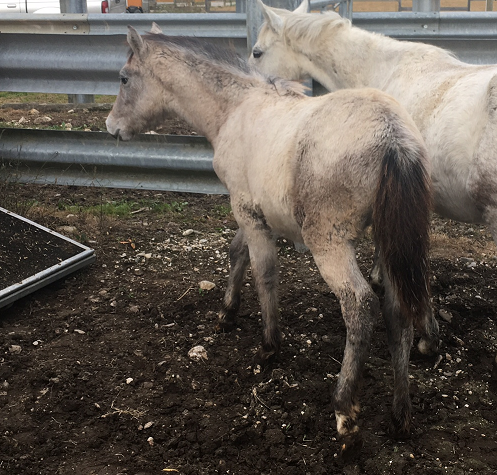
January 19, 2018: Gamine
Gamine, one of our 24-month-old fillies (rescue of the 8 horses in November 2016) had severe nosebleeds, then they calmed down. We took her to the clinic for a check-up. A shock for us, Gamine’s guttural pouches were certainly affected by a mycosis, as is often the case. A scab forms on the carotid artery, and when it gives way, the horse begins to bleed out more or less rapidly. A brief veterinary explanation: complications of mycosis of the guttural pouches in horses are frequent and severe. The condition often leads to fatal haemorrhages and nervous signs such as dysphagia or laryngeal hemiplegia. The treatment of choice today is arterial embolization, but this technique requires an experienced surgeon, equipped infrastructures and high costs. We had to make the decision to put Gamine to sleep at the clinic. A hard blow for everyone, but also for our 2 volunteers who kindly offered to transport Gamine….they stayed with her to accompany her. No words for you Gamine…a life that started badly…we put everything in place to make it a pleasant one and to end up brutally like this….Dur. Very hard to see such a nice filly go….
Victory
Victory
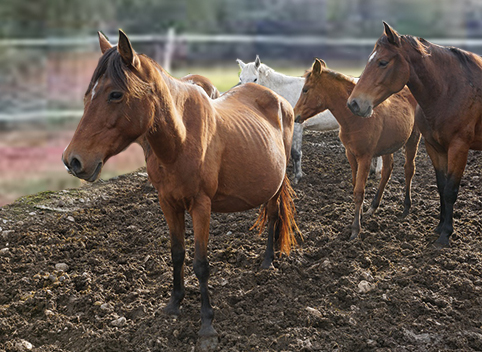
November 20, 2017: VictoryA decision that leaves a bitter taste. In October 2016, we collected 8 equines from a trafficker. 4 mares and their foals who were in the wild. All fearful and unsocialized, we took the time to put them back on their feet for 2 months. Then, once the foals had been weaned, we began the work of socialization.
The mares were brought to Antoine Cloux. It took a while for 3 of them, but most of the breaking-in was done. One of his mares, Victoire by name, showed deep-rooted signs of mistreatment. For 2 months, we worked exclusively on the ground, approaching the mare and haltering her. Every day, it was an ordeal for the mare to see a human approaching and, above all, touching her. She can’t stand the touch of a human hand; skin contact drives her crazy. Various manipulations have been tried, but with little improvement or even rebellion. Victoire throws the antecedents at anyone who comes near her.
After several attempts, Antoine Cloux decided not to continue the work, as the mare was really traumatized. We have deduced that when the owners tried to handle her to chip her a year ago, the handling must have gone terribly wrong, and Victoire must have been pinned to the ground by numerous hands…the trauma was very violent….
We’re reluctant to put him to sleep, but we’ll give it another try.
A friend from the Refuge will take her home, to her stable, to take the time for everything. Here we are, 8 months later Victoire timidly accepts to be touched, except for her hind legs. She is still inaccessible in the park, but above all, for no reason, she continues to rear up and throw her forelegs at the people taking care of her. The evolution is minimal, the mare remains traumatized by what she has experienced, contact with humans remains a permanent confrontation and she unfortunately puts the lives of certain people in danger.
It took me a long time to work up the courage to make this terrible decision, but before an accident happens, because it’s only a matter of time, I decided to put Victoire to sleep.
We’ve given her plenty of chances, but unfortunately we won’t be able to save her. We could have put her in a park, and forgotten about her…but is it animal protection not to assume these obligations? The day the mare is injured, how will we look after her? We won’t be able to: entrust her to someone else? A failure for me, for the Refuge, but you have to know how to strike a balance between the lives of humans and horses. It’s a disappointment for us to see a horse pay the price of its life because of incompetent humans who inflicted actions on it that could have traumatized it to such an extent….
Victoire has only just accepted the halter and contact after 1 year, and approaching her with a syringe and intravenous injection is just impossible. We decided to sedate her with a hypodermic gun and then try sedation before the fatal injection. With time, and also thanks to the courage of the vet who managed to inject the sedation intra-muscularly, Victoire was led out onto a grassy strip before lying down for the final injection. The seconds in these moments are long, very long. Victoire has breathed her last… she leaves this world to join a world without bipeds. A bitter taste for us all, and only one consolation remains: she will have been spared the death-row of a slaughterhouse where she was promised with her daughter.
I’d like to thank Valentine and her sister, who have given unstintingly for months, taking many risks to give Victoire a chance. And who have accepted and understood this terrible decision. Thank you to our vet for taking the time to carry out this euthanasia in the best possible way, given the conditions.
For you, Victoire, from now on, you’re free of humans… Happy trails to you, little bay mare….